Showing posts with label books. Show all posts

Sunday, November 11, 2012

TEDtalks; Crochet Pillow


Crochet pillow front, unstuffed


I've been listening to TEDtalks and working on a crochet pillow. 
The pillow pattern is from a vintage (1978 is vintage right?) book, of which most of the patterns are pretty hideous by any decades' standards.  "Fantasy coat" anybody?  But the pillow pattern is great, and I finished it up last night.  It looks bad on my couch.

Note:  Though I got through it ok, but the pattern is definitely not written in modern terms and there was enough 'you fill in the blanks of where to put this stitch' to get annoying.  I like my crochet patterns Precise with a capital 'P'!

Book: Design Crochet, 1978.  Edited by Mark Dittrick (the first 'crochet dude' maybe?)


Crochet pillow done

Crochet pillow backed with brown linen


I love TEDtalks! All the 'Ancient Clues' ones were really good.. mapping the genomes of early forms of humans and finding genetic markers in our own DNA. Neanderthal lovin! 

I also liked a talk on the 'Head Games' series about the power of smiling. Someone studied baseball cards from the 40s or 50s (I think it was) and compared how much the player was smiling vs. how long they lived. Those with the biggest smiles lived the longest!

Crochet pillow looks great on mid-century chair!


I'm still plugging away on my afghan sampler.  Must..finish....


How bout a photo of a mum?


Friday, August 31, 2012

A Casual Book Review: Palliser's Model Homes 1878

>

Palliser's Model Homes 1878, Published 1972 by Glenwood Publishers.  Hardback, no dust jacket, 1st edition


This is a casual book review of Palliser's Model Homes 1878.  (and by casual I mean little effort and less qualifications)

The bright pink and bold cover was hard to miss at the library book sale.  This book called out to me--- "Don't be a tight wad; give the lady a dollar and take me home!"

This is a faithful reproduction of the book that the architectural firm Palliser and Palliser published in 1878.  At the time, small town citizens rarely consulted an architect when building a new home.  The firm saw an untapped market and offered the service of designing beautiful and functional homes.


There are about 80 pages of beautifully drawn houses, blueprints, and a detailed description of the design.


The endpapers have illustrations as well--- this book was owned by an architectural company (note the stamp).  I wonder if they used it for inspiration?

The last few pages are advertisements for faucet heads, door hinges, wainscoting, and all the things needed to furnish and accent your new home.

This is a great little book.  It's fun to flip through, and I'm not really an architecture fan.  I like looking at the blueprints and wandering through the houses...'do I take the back staircase to the kitchen or go through the parlor?'

Saturday, June 16, 2012

A casual book review; God's Own Junkyard


God's Own Junkyard, Peter Blake; 1964,
paperback, first pressing 

Tagline: The planned deterioration of America's Landscape


God's Own Junkyard is a black and white picture book.  The first 30 pages or so are an essay on the deterioration of America's landscape, and the destruction (for profit) of the great natural beauty of this country.


The rest of the book is black and white photos illustrating this deterioration; from rural back roads to busy city streets.


This work is a bit of a dichotomy.  On one hand, it's very nostalgic to flip through and see America in the early 1960s.  The landscape that was familiar is now nostalgic to a modern eye. 


On the other hand, the warnings of the author seem even more poignant, because our landscape has been further degraded by billboards, soulless buildings, and discarded objects from our materialistic world.


Still, I find a sad beauty in the evidence of our excesses, especially when photographed so starkly, as in the photos compiled in Blake's book.  Put this book on your coffee table for casual perusal.. and some of the photos would make a hell of a t-shirt!


Wednesday, June 13, 2012

A casual book review: The Matinee Idols


The Matinee Idols by David Carroll; 1972  Hardcover, first pressing
Tagline: Here is the real, behind-the-scenes story of the magnificent stars of stage and early screen who held America's women in thrall...


I like this book, it's full of great studio stills of good looking guys- what's not to like about this....


Lou Tellegen
achingly handsome;
heartbreakingly tragic


I wouldn't call this a picture book though.  It has plenty of text, and about 25 mini biographies of the most swoon worthy guys of the early 20th century. 

As a lover of classic cinema (what I wouldn't give to have dinner with Robert Osborne) the subject matter is right up my alley. 

The glowing, hazy atmosphere of early film mesmerizes me.


Ramon Novarro and Alice Terry
The Arab, 1924


There is a modern bias against silent films.  People don't think it is possible to present a feature length plot using only gestures and a few written words. 


There is a preconception that you will be trapped into something very boring.


John Barrymore
The Beloved Rogue, 1927


But interesting things happen when you watch a silent film.. you get into the flow, you become unaware that you are reading, and suddenly you are having a unique film experience!


And there are some amazing silent films... some rival the best films of today.  One of my favorite is Sunrise (1927).  So, so good!  But my all time favorite silent film and maybe favorite film ever is Buster Keaton's The General (1926).  I think everyone should see it at least once, and I could watch it on a loop.

If you've never seen a silent film, I encourage you to give it a try! 


Wallace Reid
Joan the Woman, 1916


"Silence is of the gods; only monkeys chatter." 
                               ---- The Great Buster Keaton

Monday, April 23, 2012

Casual Book Review: Painting between the Wars


Painting between the Wars 1918-1940, Daniel Robbins, Published 1966.  From the series 'Color slide program of the World's Art.'

This book is very fun.  It is modest in size; only about fifty pages, but the real cool part is the 24 color slides that are stored in plastic sleeves in a fold out cover.


My husband spotted this one years ago at a library book sale.  We don't own a slide projector, but this makes me want to get one!  Someone got some good use out of this one, there are stains and highlight markings throughout!  The book is a little rough, but the slides are in perfect condition!

You can get your own copy over at Biblio books, my favorite online book retailer!

The one and only Matisse

I'm not very familiar with Stuart Davis' work,
but I love this street scene!

Chaim Soutine was a good friend and often sitter for
my favorite painter, Modigliani

Nice! 

Friday, March 2, 2012

Casual Book Review, Flowers and Trees of Tudor England


Notice all the bookmarks sticking out of the top.  I reference this book often!

So, this is a casual (and by that I mean mostly unqualified) review of a very sweet book in my collection entitled Flowers and Trees of Tudor England.  I think I picked this up at a used book store a few years ago, but it might have been an antique mall.  I loved it immediately and therefore paid more than I normally do for a used book, I think around $10.  I have returned to this book several times for inspiration for various craft projects.  I really love the treatment of the trees.

A brief history of this book:
So this book is a collection of plates taken from a rare and fantastic manuscript dating from around 1504 called the Ashmole Manuscript.  This 16th century 'picture book' came onto the pages of history when it was acquired by a Mr. Elias Ashmole in the mid 17th century.  Mr. Ashmole married rich and was thus able to devote himself to the softer things in life: local history, alchemy, poetry.  His eclectic collection of 'curiosities' was first housed in his own museum, but has since been split between various museums and colleges over the centuries. 

The Ashmole Manuscript is both rare and a bit mysterious, as there is little text and no hints of original ownership.  Its exact purpose is not even agreed upon by scholars.  I like the theory that it was intended as a pattern book that artists could use as reference.  As in, "hmm, I can't quite picture what a cauldron looks like.. let me get my book."

So this manuscript has over the years gathered respect and acclaim as not only beautiful stylized depictions of plants and flowers, but also as a unique source of day to day objects commonly used in the 16th century.


My book, Flowers and Trees of Tudor England, is a partial facsimile of the original Ashmole manuscript, and was published in 1972.  It is slightly over sized (almost coffee table sized), but rather thin.  The paper is thick, and the illustrations are reproduced pretty nicely.  Not the best printing technique, but nice.  There is also brief accompanying text describing each plate.  For me it is useful for what I think was it's original purpose, as reference and inspiration!


**A note: I just installed a new photography app on my phone, so pardon all the effects!  The book doesn't have furled edges, it's actually a really nice copy!

The cover; the tattered edges is a camera effect.  The book is quite solid!

Dandelion and Sweet Briar

Box tree and Pomegranate

Apple tree and White poplar


There are some really nice photos of the original manuscript pages here.

If you want a copy of your own, visit my favorite site to buy books online,   Biblio Books.

Tuesday, February 21, 2012

The Great Book of Jewels, A casual review


The Great Book of Jewels, by Ernest A. and Jean Heiniger, 1974


Are you kidding me?  This is so fantastic!  Can you imagine wearing this tiara?


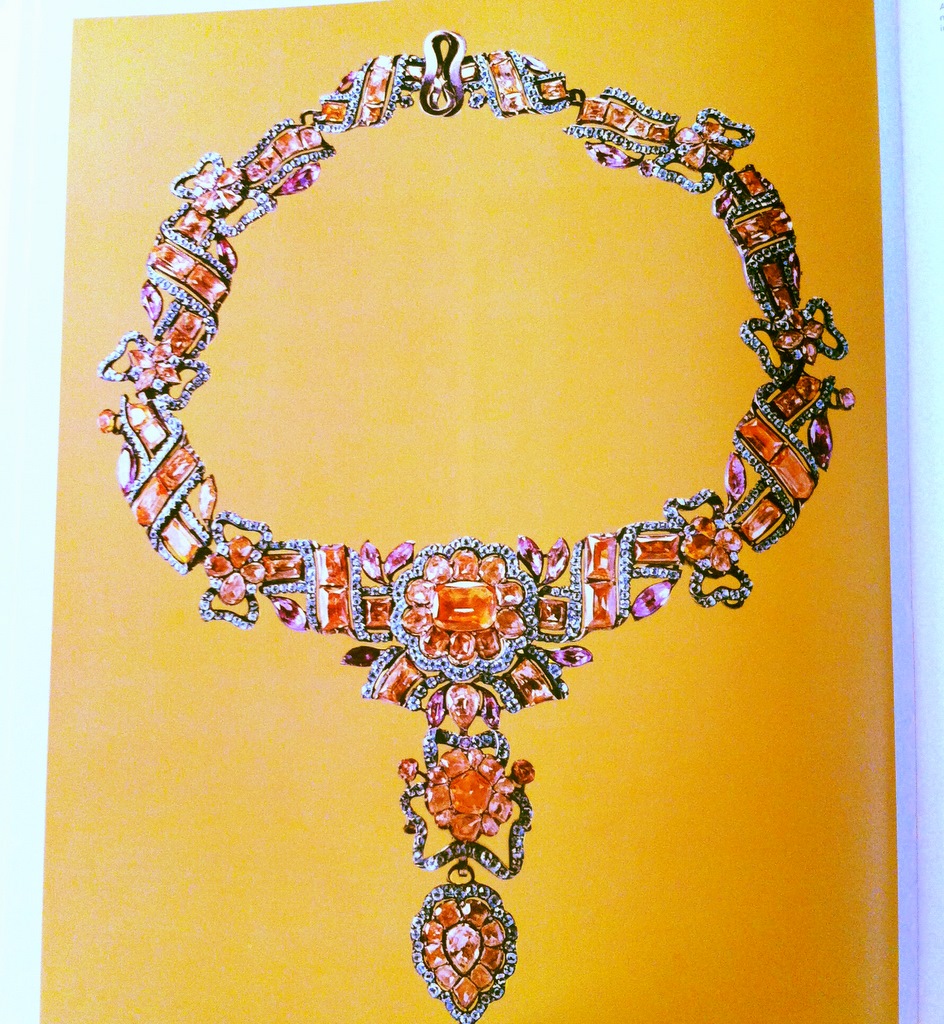
This book is impressive; it is heavy as a bowling ball and full of diamonds almost as big.  It has large colorful pictures of amazing adornments, spanning the history of jewelry making, and is accompanied by interesting and informed text. 


This beast is over 300 pages!


 The story of how a book came to be written can be very interesting.  Flipping through The Great Book of Jewels, one is immediately aware that this was a labor of love for the Heinigers.  In the table of contents, note that each section of book (divided more of less by time rather than by style, though of course these two often evolve together) is curated by a foremost leader in that particular field at the time of publishing.  For instance, the section titled "Modern Jewelry" is written by the curator of the Museum of Modern Art. 


Every chapter is written by a respected scholar


The Heinigers, very impressively, traveled back and forth across three continents over the course of five years, not only as editors but as diplomats, obtaining permission to photograph obscure and fantastic jewels. 

Many of these pieces had not been admired by human eyes for centuries, as they were in well guarded basements of museums and religious buildings, dark bank vaults, and private collections.  Each piece was photographed anew for this project, with stunning results!


Circa 935 B.C.!


This beautiful Turkish dagger dates from the 18th century.

Wow, 330 carats of diamonds!  circa 1824.


I tried to photograph the captions if possible, as they are more thorough than me.  This brooch is
so fantastic!  Dating from the 13th century, it is of two lovers holding hands.

I love everything about this!  Diamonds, topaz, amethysts, silver.
18th Century, Italian.


I snatched this book up at an antique store for the criminal price of $5. My copy is the first Switzerland edition (which is also the first printed edition). The dust jacket is in almost perfect condition, and no pages are ripped/bent.


If you would like a copy of your own, one can be found at a wide range of price points at my favorite site, Biblio Books. Happy reading!

Tuesday, January 17, 2012

Hello, Horizon!


Stack of Horizon magazines

After much thought I have fixed that the most appropriate subject for the first entry of this blog should be one relating to its title- "HelloHorizon". 
This title (also the name of my etsy shop) is a salute to my treasured collection of Horizon magazines, published from 1958-1978, by American Heritage.  This series, though technically a quarterly magazine, can be considered by its fans as much more than what is typically found on a modern newsstand. 

These magazines boast:
-Beautifully colored cloth-bound hardback covers
-Illustrations printed using the complicated/expensive photogravure process.
-Articles on the subjects of art, history, architecture, literature, theatre etc..
-Text written by some of the leading academics of the time


The cover of an issue with an illustration by the incomparable Erte

Where I got mine and where you can get yours:
I aquired my *almost* complete set, including the first edition, at a library booksale years ago.  It was the collection of a single owner, who obviously loved them and kept them in good condition. 

These books, though comparitively expensive for the time (a year's subscription of four issues would set you back $21 in 1961) are still not impossible to find today, and I often run into one or two stray volumes.  I would think a reasonable price to pay for one copy would be from $2-6, depending on the condition.

To Conclude:
These books have meant much to me over the years; they are beautiful, informative, inspirational, and so entertaining.  I often lament the lack of any such thoughtful, quality magazine today; one that is not cheaply printed and half full of advertisements, and I do not hesitate to recommend them to anyone for perusal, especially those interested in history, art, literature, etc...


An evening well spent- a latte, and a stack of Horizons!

As a final note, the American Heritage publishing co. has over the years produced many a quality book and magazine, including another favorite of mine, the American Heritage magazine, which focuses exclusively on American history.  Their website is worth a visit and can be found here.